Cast by balajis.eth
Show the cast this replies to$2048 IN PRIZES FOR VIDEOS ON NORBERT ELIAS & CIVILITY As noted above, within the Farcaster reference client, we want friend speech rather than foe speech. But really the term we’re looking for is civility. THE SHORT WAY The short way for me to explain to a crypto degen why civility is important is to make the narrowly economic case: Singapore is much more valuable than either the Soviet Union or Somalia, because its people are polite, courteous, and respectful towards each other, which means they can cooperate at larger scale, which means they can build more valuable things. So: it’s in your interest to stop being a crypto “degenerate”, even in a joking way, and instead become a regenerate. Help us regenerate civilization, starting here at Farcaster — because we can build far more valuable things together (including physical things!) if we can re-establish the base of civility that underpins a high-trust society. THE LONG WAY The long way for me to explain why civility is important is to (a) refer you to a series of good books and then (b) ask you to make 59 second vertical videos out of those books, summarizing as much of the gist as possible. Start with Norbert Elias’ book, The Civilizing Process. The rough background is that Europe was civilized (during Rome), then it became de-civilized (during the Dark Ages), then it gradually re-civilized (starting well before the Renaissance). How did that re-civilization happen? Elias shows through the study of centuries of Middle Ages etiquette that Europe rose out of its post-Roman collapse in part by adopting good interpersonal manners. In modern terms, manners were a peer-to-peer signaling mechanism between strangers showing that the other person’s animal impulses were firmly under control. Once Europeans could trust each other on extremely small things, like whether they were going to spit at the table, they could potentially trust each other on larger things…and thus did scaled cooperation return after the end of Rome. In tandem with this (literally) peer-to-peer civilizing process, Europeans started to gradually recentralize. Instead of the thousands of competing warlords that arose after the end of Rome, a few royal houses gradually consolidated a monopoly on physical violence, such that every interpersonal slight didn’t immediately result in a potentially murderous brawl. You can try ordering the paperback by Elias (amazon.com/dp/0631221611) or read a decent review (researchgate.net/publication/248991628_The_Civilising_process_A_review_of_Norbert_Elias), but because a Kindle copy isn’t available in English right now, you can also get pretty far by querying an AI model that has indexed the full text. Start with a query like this: “Tell me about Norbert Elias’ book, which shows how modern state capacity and complex markets arose as Europeans re-learned self-restraint and manners. The counterintuitive point by Elias is that civilization is dependent on seemingly trivial peer-to-peer behavior, like table manners, and not just laws or capital.” The reason I reference this book is that today’s social media is much like the Medieval Europe Elias studied. It's a place where anyone can attack anyone at any time, with essentially no central authority to stop disputes from spiraling out of control. A big part of what got Europe from the dark ages to the nation state era was the concept of civility; that's also what we think will be crucial for moving from today's internally combative social networks to network states. YOUR TASK Make a ~59 second vertical video with a 9:16 aspect ratio on the evolution of civility, and how it enabled large-scale interpersonal cooperation, starting with Norbert Elias’ work. Assume your viewer has absolutely no context and is starting cold. Talk to them in concrete terms anyone can understand, in terms of why a group that’s mutually polite to each other can be more successful economically (in terms of creating wealth) and physically (in terms of increasing safety) because they can cooperate at larger scale. We’ll give $1,024 for first place, $512 for second place, and then $128 each for honorable mentions, subject to whether there are enough good submissions. Winners will be paid in USDC to their public Farcaster wallet addresses by default. To enter, reply to this post with your vertical video. This prize will run for three days exactly from this post’s timestamp. That's it. Our journey of one thousand miles starts with a single step. Go read a book, or at least ask an AI about it if you can't get a copy. Then make that vertical video on why civility is economically necessary, and help restore friend speech on Farcaster!

28 replies
You mentioning the USSR in this way is hilarious since you are now in a former USSR republic. For those that don't know, Malaysia booted this man and Network School out of the country. They had tried to locate nearby Singapore but they violated the law of Malaysia and were forced to leave.
I want to know more about this. I will do some searching, but if you have links at ha d I would like to check them.
Sure

civility is not politeness. It is the social technology that lets strangers share space without a king holding the violence.
Table manners weren’t about etiquette, they were Medieval Europe’s original P2P trust protocol. A 58 second breakdown of Norbert Elias’ The Civilizing Process and why baseline civility is the economic engine behind high-trust societies, modern Singapore, and future network states. Hope you like it! 🫶
Who would have thought that humans would move from shouting commands like “off with his head” to learning how to live and work together Maybe Norbert Elias was onto something. Being civil is not about having good manners, it is about building trust, and trust makes it easier for us to work together, build businesses, and create value. And that’s kinda the point of bringing friend speech back to Farcaster, isn’t it? 🌚 @balajis.eth
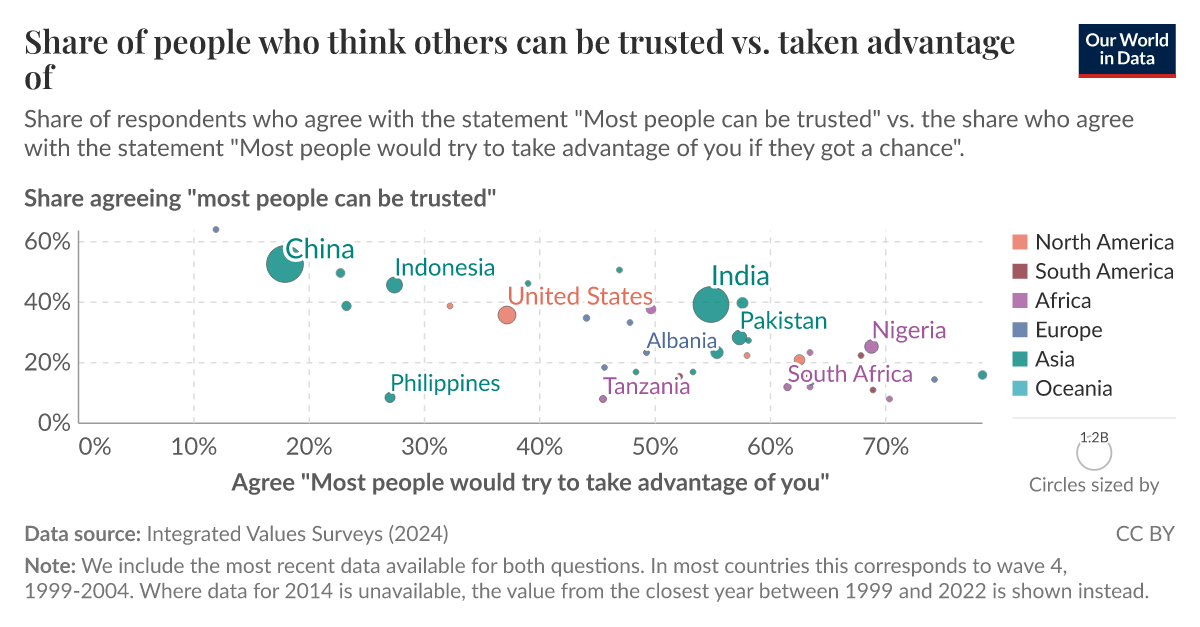
Explored that Singapore stat more closely. Trust there is 34%, below America’s 37% 👀 and Denmark: 74%*. What’s world-class is predictability: #2 for safety, #8 for courts. So what makes behavior predictable? Is the lever politeness, or reliable enforcement? Elias: courtiers traded swords for etiquette once kings monopolized violence. Manners stuck because enforcement was predictable. Farcaster is increasingly nudging towards its initial vision: one protocol, several clients, each (wittingly or no) running its own norms experiment. Singapore took decades to find out. Farcaster gets to run several versions in parallel. Fun to watch. *
Here is my entry @balajis.eth Farcaster is choosing friend speech over foe speech. Civility isn't weakness. It's how strangers build wealth, safety, and things none could build alone.
Civility is more than just good manners. It builds trust, makes cooperation possible, creates wealth, and helps keep society safer. Inspired by Norbert Elias, this is how the way we treat one another can change the world. 🌍 #Civility #NorbertElias @balajis.eth
Norbert Elias explored how self-restraint, social norms, and state formation transformed human societies. I tried to capture the idea in 59 seconds. What do you think? @balajis.eth
Civilization starts with how we treat each other. The internet has made it easier than ever to connect, but connection means little without trust. And without trust, how far can we really go together? That’s what makes the conversation around civility on Farcaster important. Sometimes, building a better internet starts with something as simple as learning to treat each other better. #Farcaster
Here is my entry sir @balajis.eth I tried to put my all efforts to make it impressive and easy to understand! Hope you like it! ☺️
My submission @balajis.eth I believe we can turn farcaster into a digital Singapore (civilized), which is more valuable than a digital somalia. Manners maketh man. We can achieve much more when we are polite to each other and civilized. I believe that civilization will help us come out of the dark ages and build network states. It's time for us to be regenerates my farcaster friends 🔥🔥.
Civility is more than just good manners — it’s the foundation of trust, meaningful connections, and communities that thrive. This film explores how a simple idea can shape the way we build the internet together.
I used to think manners were just about being polite. Then I read Elias, and it clicked. Manners were the first test between strangers. Pass the small test at the table, and people trust you with bigger things. That's how a place like Singapore went from $500 to $90,000 a person. Now our tables are online, and the same test is back. That's friend speech to me. @balajis.eth
Inspired by Norbert Elias and the vision for a digital Singapore, here is my entry on why restoring 'friend speech' on Farcaster matters
Hello @balajis.eth this is my entry. I pay strangers before they ship my order. That used to sound crazy. Then I learned trust is not about being nice, it is about being predictable. Farcaster is testing that now, one protocol, many apps, all trying friend speech. If strangers can be polite and predictable here, they can build a digital Singapore together.
@balajis.eth ITS ME I say sorry to a stranger in a lift without thinking. Then I read Elias and Erasmus, and it clicked. Small manners were the first test between strangers. Pass that test, and people trust you with bigger things. Singapore proved it, strangers there got rich on trust. Now the same test is online. That's friend speech to me.
Eight billion strangers share one planet, and somehow we do not fight all the time. I learned why. Small rituals, a smile, a queue, a thank you, a bow. Elias showed they are not decoration, they are a promise. I will not hurt you, you will not hurt me. Now that promise is online. Keep our words kind and honest, and strangers will become friends. That's friend speech to me.
Thanks for all the videos! We are reviewing them now and the @farcaster will handle payouts and winner announcements. farcaster.xyz/balajis.eth/0xfe595d98
Thanks also for this exciting bounty, I had fun reading the book and making the video
sounds like a fun one, reading the book then making a video out of it is such a cool combo 🙌
Missed the deadline by about an hour, but I put real effort into this and wanted to share it anyway. 59 seconds on Norbert Elias and why civility is infrastructure. Would love for you to watch it @balajis.eth 🙏
@tldr @phil did you see this? Prof and I are talking about you on @gmfarcaster saying we’d love to see your pov on this