Cast by wbnns
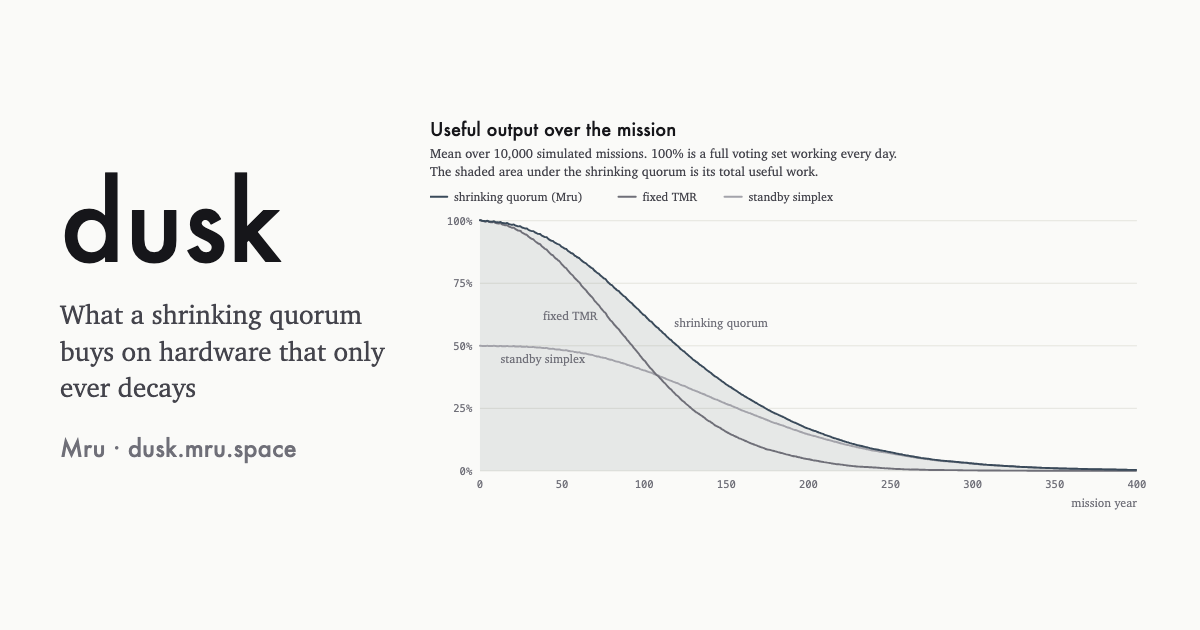
Show the cast this replies toHeya, by design it loses hardware and keeps working with less. Graceful decline is the goal (so technically not anti-fragile!) What surprised us: + In orbit, nothing did. The laptop, the test bench and the satellite gave the same counts + Reaction time barely matters; if a ground team switches a failing system over in 1 day or in 6 months, total useful work comes out the same + Our approach isn't always best. If spare processors stay switched off and age slowly, keeping them offline does more work (we observed this in our simulator) + It has a cost. In 20% of simulated missions, it gives at least one wrong answer in its last years on a single processor. Standard triple voting gives none, but it stops much sooner For the long horizon we use Dusk, our open-source simulator: 10,000 missions over 1,000 years, no repairs. Processors wear out faster as they age, take random bit flips, and sometimes fail together We sweep every number we aren't sure of dusk.mru.space
1 reply
@wbnns really cool that you're sharing all of this in public here. Graceful decomposition sounds like a term from Karl Friston… You're bringing me back to the organic biology class I never took. In doing some research for ARCS, I discovered that the conscious mind clock rate is btw 30-50 bits / second. We're running very basic software on very old hardware with a bios that has been hardened by epochs and with a firmware that doesn't trust it's updates. So many rules are pre-conscious etched reflexively on our evolutionary ROM. How many unpowered spares are there on deck? And what happens if it ages faster than the 0.2 of the powered rate? Might not be a bad idea to buy the domain dusk.md or at least until Romainia stops selling them. At a high level, it made me think of that show the Three Body Problem and the multi-epoch interplanetary mission.
Thanks, appreciate it :) The biology overlap is real, a lot of the design borrows from how cells are built (not how evolution works) WRT spares: the default model has 3 processors, all powered, no extras. The cold standby baseline uses the same 3, with 1 on and 2 switched off... and you can add salvaged spares with --spares N If a cold spare ages faster than about 0.2 of the powered rate, our approach does more useful work, up to 1.6x when spares age as fast as powered ones. Cold standby also gets more wrong results at every rate (43% to 61% of missions vs our 20%), because it never votes Still haven't read the Three Body Problem, might need to carve out some time to get around to it!

The 20% is the number I keep looking at. With three, the vote tells you when one is wrong. Down to one, nothing can. Does the last processor know it's alone and mark its answers as unchecked, or do they look the same as when three agreed? For whoever reads them on the ground, that label might be worth more than the extra years.
the cell biology angle is such a neat way to think about it — nature's been optimising that design for billions of years, makes sense to borrow from it. and honestly yeah, carve out the time for three body problem, it's a proper ride once you get into it