**One line became this post. This is the first.** It's my intent but it's not my words. I have mid grammar and I struggle with dyslexia. I've written articles in the past but there's something special to the added ability I have now-- which is taking a story I believe in and putting it into the right words and format. **So I'm going to write more long form.** Opinions on AI grammar be damned, I choose to not remove punctuation to pretend it's more mine. Unfortunately, because AI writing is zero-cost and produced in mass volume, the easiest way to filter out slop is to classify all AI writing as slop. I understand why people feel this way. I make a best effort to move away from the generic signs of AI writing, and it's an uphill battle. This post is AI co-written. I'm trying to create AI writing as a skill that doesn't have to produce slop. I also want to understand the hidden effort behind an article. That effort is often invisible without the thinking and conversation that led to the result. It's important that this was a conversation, not just a prompt. My thinking is rough and unstructured. I pass it to an LLM to clarify a final form. LLMs pull every draft toward the average. The work now is to pull each draft back to what I mean. That's what I thought, anyway. Most of what I meant showed up when I said no. A no is a message where I questioned or rejected what the LLM wrote, and said why. I quote my prompts as typed. # Who pays to check **AI writing filter:** Ignore all writing that looks AI. A friend and I talked about that filter. My pushback: > language is like engineering. we're essentially engineering an idea to put into someone else's brain. > When it comes to AI code, engineers dont seem to care. but with writing, people seem to really care. > Why is this? His Claude answered: > Engineers don't care about AI code that passed the tests. They care a lot about AI code they have to review. [...] The variable is who pays to check the work. Code has a machine for that. Prose has only the reader, so readers discount AI writing because otherwise they are the unpaid test suite. Claude's example: in 2025 curl's maintainer wrote that [a fifth of their security reports were AI slop](daniel.haxx.se/blog/2025/07/14/death-by-a-thousand-slops/). Each was prose three or four people read. In January 2026 curl [ended its bug bounty](theregister.com/security/2026/01/21/curl-shutters-bug-bounty-program-to-stop-ai-slop/5063039) over the flood. My friend read a draft and added this (Pangram is an AI-text detector): > [...] a pet peeve I have in support is ppl sending AI slop. I've noticed that some of the most annoying people in support have 100% AI when I throw it in pangram > [...] fundamentally I feel like this person is just wasting my time. Like they are not pumping out slop, it is that they are sending it to a place where someone's job is to have to read and respond. Slop is text the writer never checked. Someone still pays to check it. The writer pays before sending, by saying no. Or the reader pays after, as the unpaid test suite. # Two layers When I asked Claude to "Think through the article and the entire conversation at the highest levels of abstraction-- what is evening happening right now," its first answer began: > Two parties with opposite gaps. You have the intent, but the words cost you. The model has the words but no access to your intent. [...] Those are the two layers: intent and words. Feynman's [1974 Caltech talk](calteches.library.caltech.edu/51/2/CargoCult.htm): "you must not fool yourself—and you are the easiest person to fool." I pushed again. We are the writers. # Is this still mine? The no's are the work. Claude's first answer to "what is evening happening" also said why: > [...] You say no and say why. The reason is the new information. Often you did not know it until you saw the wrong version. My no's weren't all good. I wanted this post under 30% on Pangram. I typed: > I don't understand. You should rewrite our draft to appear human written, pangram is just detecting norms which AI use to classify it as AI writing. [...] That's the challenge. It's possible. Many prompts later I typed "That's not true dude our prior work has been under 30% and fully ai generated. [...] think like you're on the offensive to solve this, then solve it." My take after the Pangram scans: > The pangram thing worth noting although micro edits seemed to work-- what's actually dragging it down is just including my original prompts (which are actually pretty useful/interesting). Pangram's [technical report](arxiv.org/abs/2607.27183) explains why. It's hard to beat. |version|Pangram| |-|-| |the LLM's own draft|94% AI| |the LLM rebuilding it from my prompts|24% AI| |this post|~45% AI| I was wrong about the norms. My two no's about Pangram fail. Passing as human also went against my line on punctuation. I kept the prompts, and Claude's answers too, though the answers push the score up. For a co-written post, a mixed score is the expected result. The score can't show where the ideas came from. **They came from the conversation. The rejections (no's) were usually mine.** # 80% of the way to ASD-STE100 The tip I took came from Andrej Karpathy's October 2 post: [$1] Karpathy has his LLM explain things in ASD-STE100, a controlled English first made for aircraft maintenance manuals, so non-native English speakers can follow them. It's strict, so he sometimes asks for "80% of the way to ASD-STE100." He uses it to read what the LLM says. I started by using it to limit what goes out under my name: one idea per sentence, short sentences, active voice and plain words. The other 20% is meant to be my style. I'm not sure it ended that way. The instruction is the easy part. ``` write in ~80% ASD-STE100. ``` The 20% is the hard_(er)_ part. # The prompts I'd use again Where a row quotes a line from this post, put in yours. |when|what I typed| |-|-| |a line reads fine, but I can't say what it means|the line in quotes, then "I don't understand. eli5."| |it guesses what I meant|"that's not correct though. we have to be more rigorous about what we say."| |it states a fact I can't trace|"where is this from?"| |I've said no a lot|"step back and analyze this conversation-- abstract every message into something beyond exactly what it says"| |my edits get small|"We want to understand the mechanisms of what's happening, not the length of the sentences in the article."| |the answer is true but flat|"you missed something extremely critical" (then check what it found against your messages)| |every draft is good and none is mine|"Restate what you believe my true intent is-- stated vs revealed"| |I've lost the thread|"Eli5 the narrative back to me [...] what you think i wanted it to achieve + what it actually achieves now (precision accuracy)"| |the point comes late|"A cofounder once told me to put the end at the start. That's how a CEO reads."| |I think it's done|"treat it like a security problem, you're trying to poke holes in it (vulns) or compose holes into a stronger anti-argument (a chain attack)"| |I can't judge its argument|"make a more rigorous report and argument around this that i can give gpt to critique"| |it keeps adding|"Less is more. Consolidate majorly."| # The sheet Claude's answer to "what is evening happening" also named the drifts: a draft that restated Karpathy (Purpose), a [1], [2] reference list at the end (Context), the "Try it" ending (Voice) and the Feynman technique, which isn't his (Truth). Claude drew the sheet from the drift names. I typed "It's almost like our Article is a skill file for AI." The sheet is that file. Give it to your LLM with an idea and start a conversation. [$2] The checks, if you want to paste them: ``` Flag each drift in this draft. Quote the line. Purpose: Does it use the idea, or only repeat it? Context: Does it fit my tools, my platform and my readers? Voice: Is this what I mean to say? Truth: Is each claim true at its source? Order: Does the reader get the point before they stop? Surface: Does it do what the example does, or only look like it? Level: Will it help with the next piece of writing? Provenance: Does the piece say whose words these are? If words have more than one owner, name each owner. Cohesion: Between any two sentences or sections, can you put "so," "because," "but" or "for example"? List each break. Security: Where can you poke a hole? Do the holes chain into a stronger argument against it? If you can't tell what I meant, list the readings and ask me. Don't rewrite on a guess. ``` A no only catches what I can see. If the LLM drifts somewhere I can't see, the drift stays in. So the checks end by asking me. An earlier draft swapped my friend's words and mine. I caught that one, and later checks caught more of his, and Claude's, passing as mine. In September, [Thomas and Erin Ptacek posted](sockpuppet.org/blog/2026/09/17/how-to-write-with-an-llm/) the opposite rule: "You may not use a single word an LLM suggests to you." Their reason is drift you can't see. I take that risk because the second layer isn't cheap for me. Paul Graham's advice: "expect 80% of the ideas in an essay to happen after you start writing it." [$3] So I wrote one line: > I'm going to work on transitioning into a more long form style of writing as i prepare for the next phases of my life. The ending I said no to was "Try it. Write one line about a decision. Ask why. Then ask how. [...]" It wasn't my intention. The one line was a promise, and the ending has to keep it. **One line became this post. This is the first.** --- # The credits They're all the result of the same conversation_(s)_, but here's who wrote each idea.
Death by a thousand slops
I have previously blogged about the relatively new trend of AI slop in vulnerability reports submitted to curl and how it hurts and exhausts us. This trend does not seem to slow down. On the contrary, it seems that we have recently not only received more AI slop but also more human slop. The latter … Continue reading Death by a thousand slops →

Curl shutters bug bounty program to stop AI slop
: Maintainer hopes hackers send bug reports anyway, will keep shaming ‘silly' ones
Cargo Cult Science

Pangram 4 Technical Report
We present Pangram 4, the latest deep-learning-based AI-text classification model from Pangram Labs. We achieve an AUROC of 0.9916 with a false positive rate of 0.0041% and a false negative rate of 0.3396%. In addition to its increased overall accuracy compared with Pangram 3, Pangram 4 exhibits superior out-of-distribution generalization and robustness to adversarial attacks. Another novel contribution of Pangram 4 is its improved ability to distinguish fine-grained edits and mixed AI-human co…
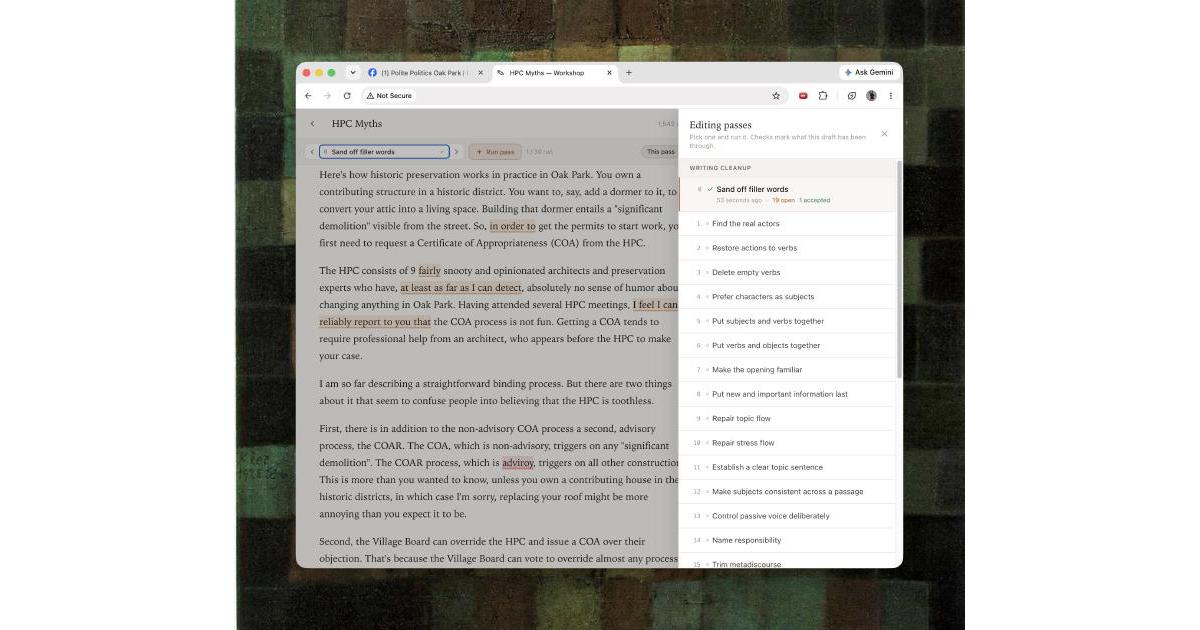
How To Write With An LLM
Two rules keep an LLM from pasteurizing your writing: never take a word it suggests, and never let it encourage you. Then hand it all the tedious work.