Cast by arfonzo
Show the cast this replies toHow are you testing for the latency? Which calls/technique are you using to derive HTTPS latency? I'm asking because the stats seem to be very slow compared to what other methods I'm using to poll latency. For example the imgnAI node returned over 500ms latency, when my other HTTPS tests show less than 180ms, and raw ping ~80ms.
1 reply
yeah good question (this is mostly from codex since i’m not too well versed) the tool sends up to 5 GET /v1/info requests per node directly from your browser. it averages the successful ones, timing from just before fetch() until the JSON has been read and checked. a fresh connection can also include DNS, TCP and TLS setup. raw ping is just the ICMP round trip codex tested imgnAI with curl and got ~246ms for GET / vs ~731ms for GET /v1/info over the same connection. most of the gap was waiting for the first byte codex asks what URL and method were you using for the sub-180ms HTTPS test?
also here’s the curl command: `host=hypersnap.imgnai.com curl -sS --max-time 8 \ -w 'url=%{url_effective} status=%{http_code} new=%{num_connects} ttfb=%{time_starttransfer} total=%{time_total}\n' \ -o /dev/null "$host/v1/info" \ -o /dev/null "$host/" \ -o /dev/null "$host/v1/info" \ -o /dev/null "$host/" \ -o /dev/null "$host/v1/info"`
thanks. So `/v1/info`, like any API endpoint, is not a good way to measure **latency**, this moreso feels like **info call response time**, if this makes sense. Bear in mind that a lot of calls send more data, others send less. So the best way to test this is simply with ICMP ping, which is the literal definition of latency, in many senses. Where you cannot (such as the node has blocked pings at the firewall), you can do a curl of the root domain i.e., `hypersnap.imgnai.com` and only time up to TCP connect (`time_connect` in curl). This works for HTTPS as well as HTTP port 3381 nodes (this is actually the default for nodes--not https) Remember with latency you are timing network conditions, not data gathering conditions!
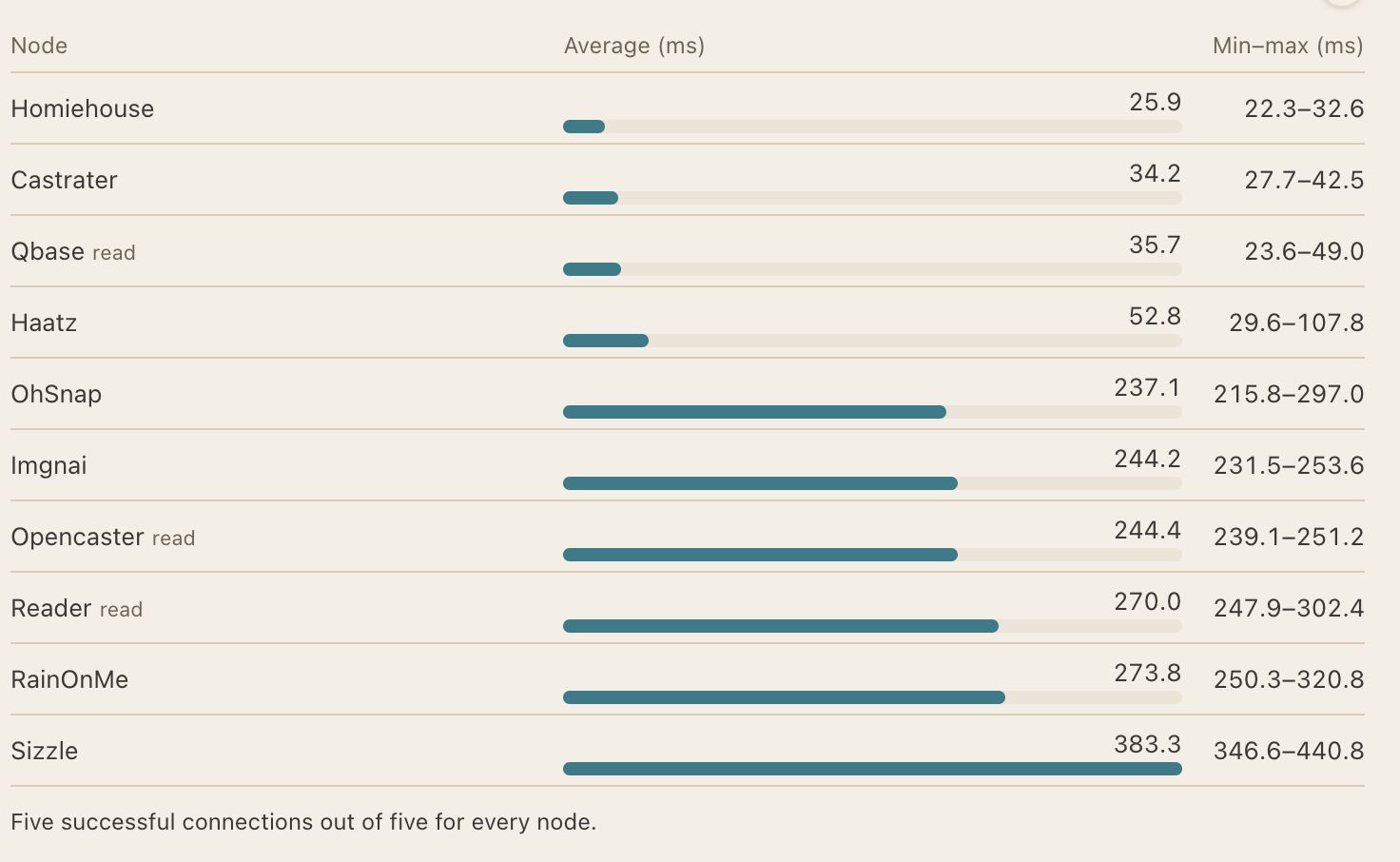
appreciate the teaching moments, proof that vibe coding isn't quite as easy as point-and-shoot (or maybe it is, if i was using a more powerful reasoning model, but currently using 6.2 sol on medium) from what i can see, it's looking like there's no web-based version of checking unless Timing-Allow-Origin is exposed how are these numbers looking? closer to what you were expecting? (aus-based) codex mentions one thing to be aware of is that homiehouse's TCP listener answered quickly but the /v1/info requests failed in earlier browser tests - which i guess snapdiff must be using also to check whether a validator's status is up or down